
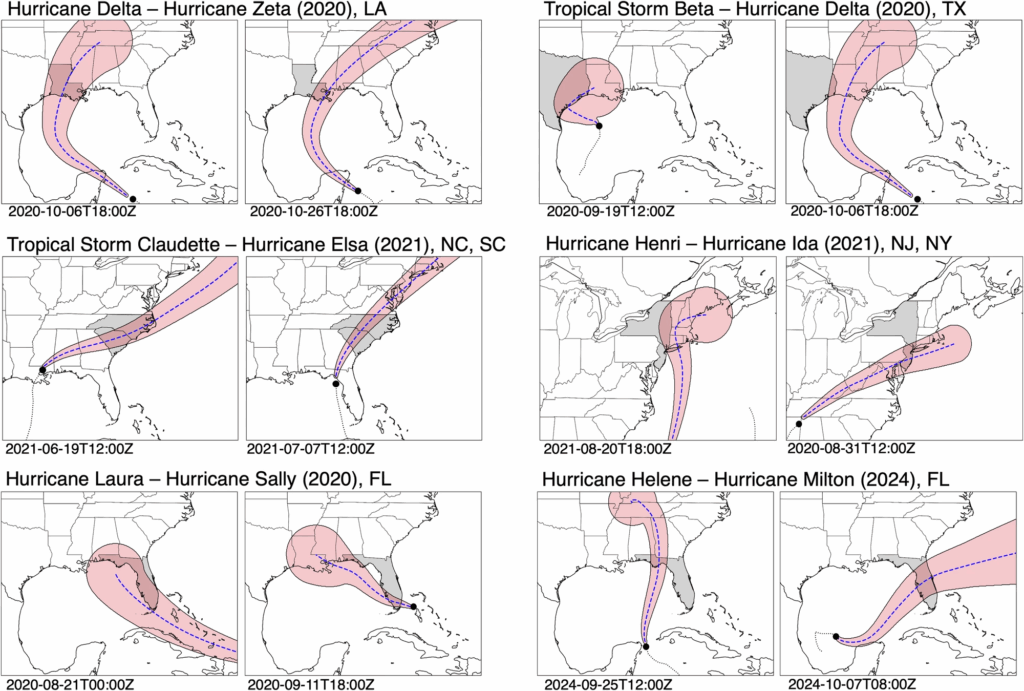
When two tropical cyclones strike the same region of the U.S. within weeks—a scenario increasingly likely due to climate change—communities show a counterintuitive response: preparedness actually declines for the second storm despite often stronger forecast winds, according to a research study published in Nature.
Researchers analyzed mobility patterns as a proxy for preparedness across seven U.S. states from 2020 to 2024 and found that while stronger forecast wind speeds correlate with higher preparedness levels overall, the effect weakens significantly for subsequent storms.
“The temporal compression of their impacts can strain community preparedness by quickly depleting resources, complicating risk perception, and limiting the time available to restock supplies, make repairs, and recover between events,” the study’s authors said of storm pairs.
The data reveals a troubling dynamic. Communities demonstrate higher levels of preparedness for the second landfall when controlling for intensity alone, yet they become less responsive to forecast wind speeds themselves. This suggests that instead of ramping up efforts proportionally to increased danger, stressed populations experience psychological fatigue and resource depletion that dampens their protective response, according to the study.
Infrastructure Disruptions Drive Future Preparedness
One silver lining emerges from the data: power outage experiences from the first storm substantially increase preparedness for the subsequent one. Every percentage point increase in previous peak power outage experience corresponds to an average 0.12% increase in mobility needs preparedness and 0.25% increase in structural reinforcement preparedness.
Power outages prove more influential than wind intensity or rainfall when predicting how communities will prepare for a follow-up storm, the study found. This suggests that the tangible, immediately felt consequences of infrastructure failure—loss of electricity, communication disruption—register more viscerally than meteorological data.
Vulnerable Populations Face Compounded Disadvantages
Communities with higher proportions of young children, elderly residents, people with disabilities, limited English proficiency, and households without vehicles consistently demonstrate lower preparedness levels across all three major preparedness categories: mobility needs, daily supplies, and structural reinforcement.
These disparities become more acute during sequential storm events. The temporal compression of back-to-back hurricanes leaves already-vulnerable populations with minimal recovery windows and depleted resources. Limited transportation options and accessibility challenges compound the difficulty of visiting gas stations, grocery stores, and hardware retailers during compressed preparation windows.
The research underscores that simply increasing the density of available resources—more stores and service centers—does not translate to increased preparedness without addressing underlying barriers of accessibility, mobility, and awareness.
View the full research study here.